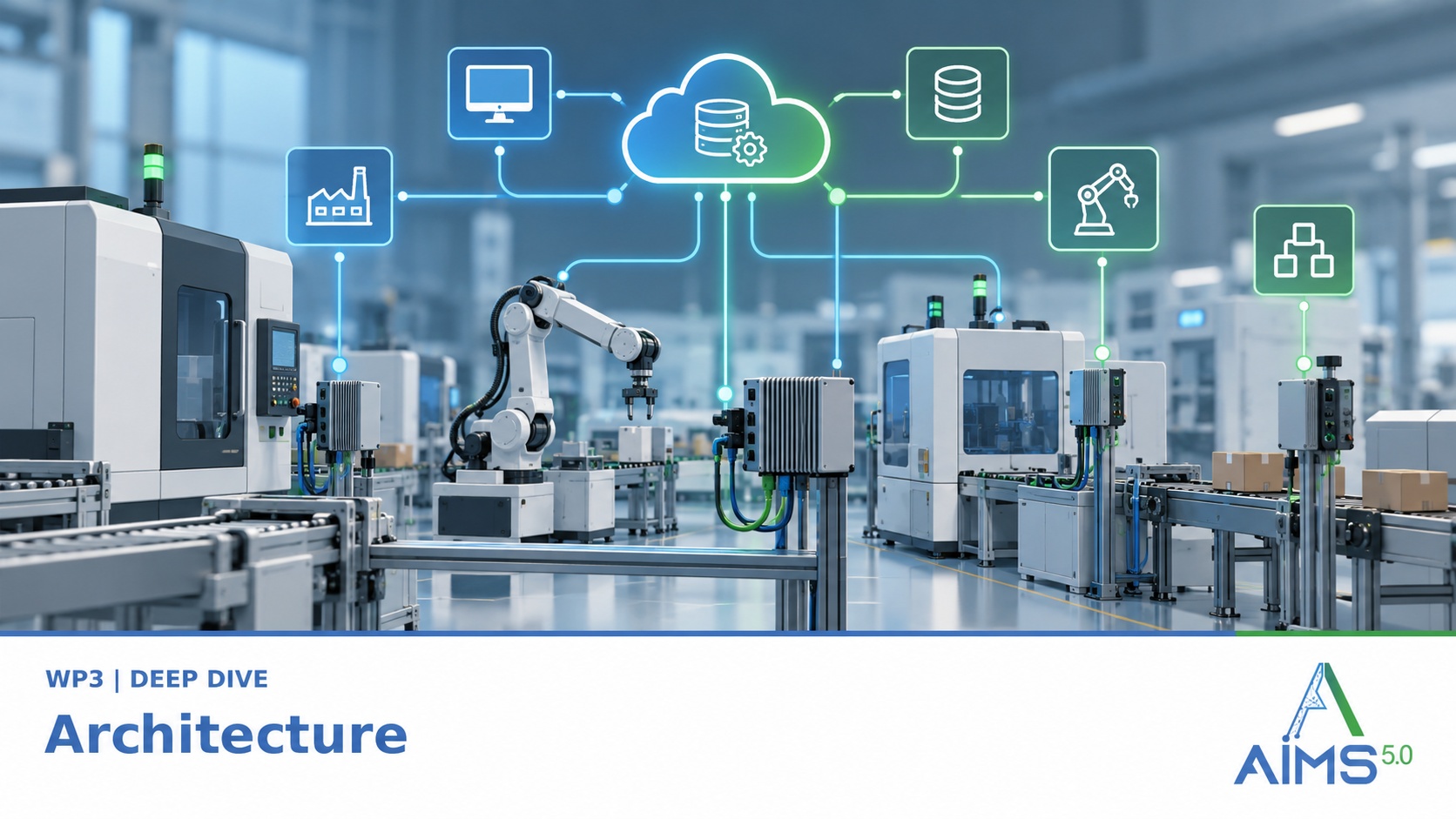
AIMS5.0 Deep Dive, part 3 of 9 · Work package 3: Cyber architecture for AI-supported sustainable production
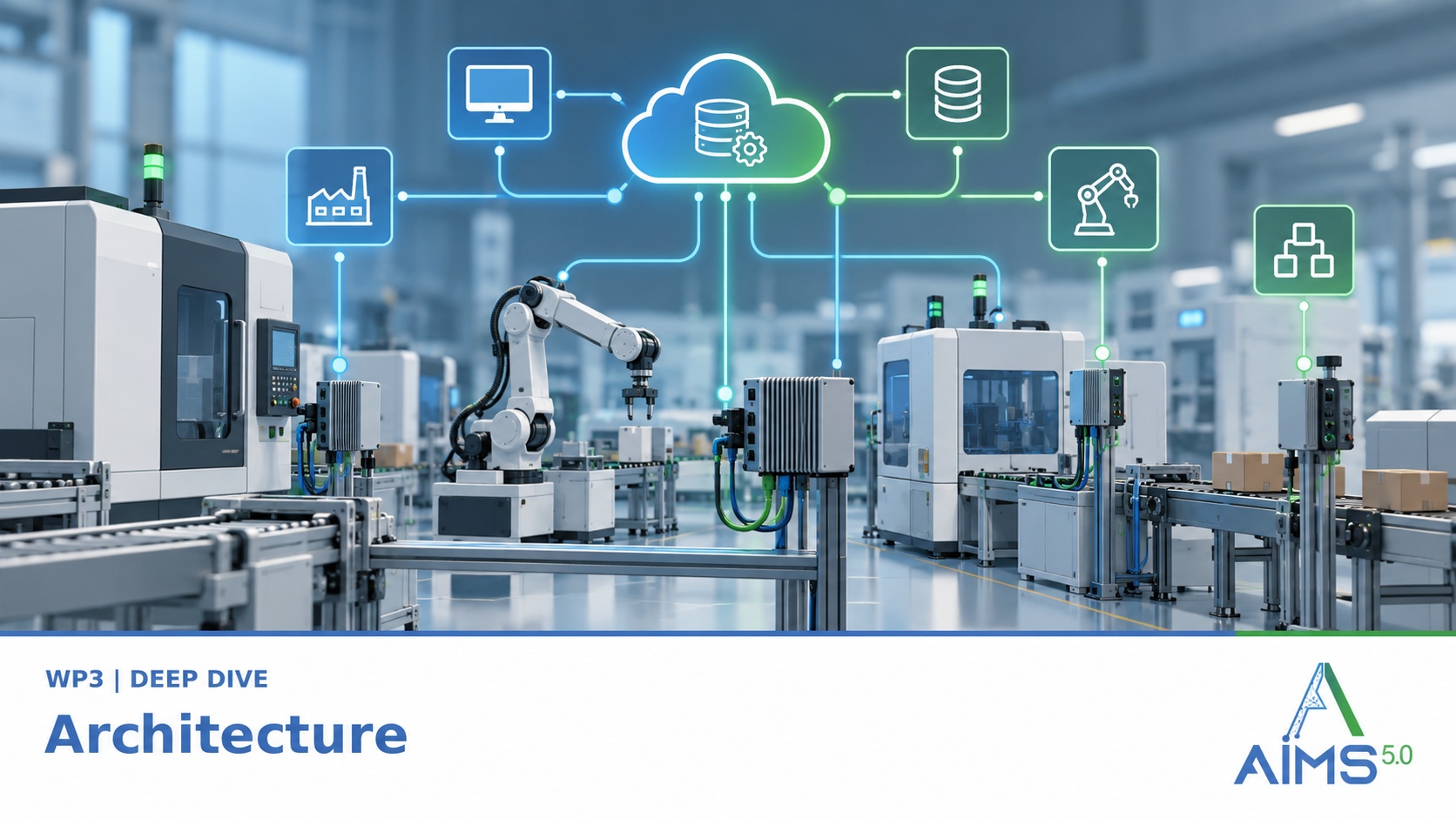
Industrial AI is usually discussed in terms of models and accuracy. In a factory, the harder question is how an AI function becomes part of the running system: how it gets the data it needs, how other software calls it, who is allowed to use it, and how it is updated without stopping production. Work package 3 (WP3) of AIMS5.0 developed the architecture for this. It was led by Luleå University of Technology (LTU), with TTTech and AITIA among the main contributors.
WP3 built on Eclipse Arrowhead, an open-source framework for service-oriented industrial automation. In Arrowhead, machines, sensors and software applications offer their functions as services. Core systems register these services, orchestrate them and control who may use them. The aim of WP3 was to extend the framework so that AI functions can be integrated, tested and deployed at the edge, and to contribute the results back to the open-source project.
Scope of the work package
WP3 covered the composability of systems, software development, service orchestration, safety and security, with sustainability as a requirement throughout. The extensions had to work with AI functions from work packages 1, 2 and 4 and support the industrial use cases in work packages 5 and 6. A further target was an engineering methodology that lowers the cost of building such systems by 10% to 30%, based on the earlier Arrowhead Tools project.
The work was organised in four tasks: requirements and coordination with the other work packages, a micro-service platform for AI integration at the edge, an AI-gym for testing AI components, and input to standardisation. The partners met for workshops in St. Pölten (2023), Luleå (2024 and 2025) and Lisbon (2025).
Contribution to Eclipse Arrowhead 5.2.2
The main software result is the contribution to Eclipse Arrowhead release 5.2.2. Five support systems were migrated from version 4.6 to the new version, together with their documentation: DataManager, SysMonitor, EventHandler, Gatekeeper and GateTunnel. The release also adds support for real-time networks. Release notes and documentation are available on the Arrowhead 5 documentation site.
Together with work package 2, the team also worked on an engineering co-pilot that supports developers when they design Arrowhead-based systems.
The AI-gym
Before an AI component goes into production, it has to be tested under conditions close to its later use. The AI-gym provides an environment in which AI functions can be tested and validated as services and then integrated into an Arrowhead system. During the project it was used by work packages 1 and 2. It is now released as a support system within Eclipse Arrowhead and available to every user of the framework.
Model-based engineering with SysML v2
Complex automation systems are increasingly designed with models rather than documents. WP3 developed an Arrowhead domain-specific language (DSL) that describes service-oriented systems in SysML 1.6 and in the new SysML v2, for Arrowhead versions 4.6 and 5.2. Together with the Arrowhead fPVN project, the DSL was implemented in Eclipse Papyrus. It was proposed to the Object Management Group (OMG), which maintains the SysML standard, and presented by CEA, LTU and PTC at the OMG technical meeting in Reston in April 2026, where it received positive feedback. The team also proposed extensions for sequence diagrams and state machine coding in SysML v2.
Standards and regulation
Eclipse Arrowhead already builds on a large set of established standards. WP3 assessed four AIMS5.0 use cases in detail against the relevant standards and identified where further work is needed: automation of engineering processes, orchestration along the edge-to-cloud continuum, and tools for model-based systems engineering. The team also mapped the architecture against the Cyber Resilience Act and the AI Act. Some requirements are only partly supported today, which sets out the next development steps.
Use in industry and teaching
Arrowhead is already used in industry. Sinetiq developed and installed an Arrowhead-based manufacturing execution system at Scania, and Thingwave sells a product line based on Arrowhead in Europe and Australia. Arrowhead is also part of bachelor's and master's programmes at LTU in Sweden, BME in Hungary, the University of Bologna in Italy and the University of Oulu in Finland.
Several new projects continue the work. PRISMA, a four-year project funded by the Research Fund for Coal and Steel and coordinated by LTU, uses Arrowhead for information exchange in the steel industry, including digital product passports and life cycle assessment. AI4SDV and Shift2SDV apply the service-oriented approach to software-defined vehicles. The Eclipse Arrowhead community also holds open meetings every two weeks, which are published on YouTube.
The WP3 team will be at the AIMS5.0 booth at EFECS 2026 in Helsinki on 2 and 3 December. An overview of all nine work packages is available in the AIMS5.0 final results article.
The AIMS5.0 project is supported by the Chips Joint Undertaking and its members, including top-up funding by National Funding Authorities from involved countries under grant agreement no. 101112089.


 Imprint
