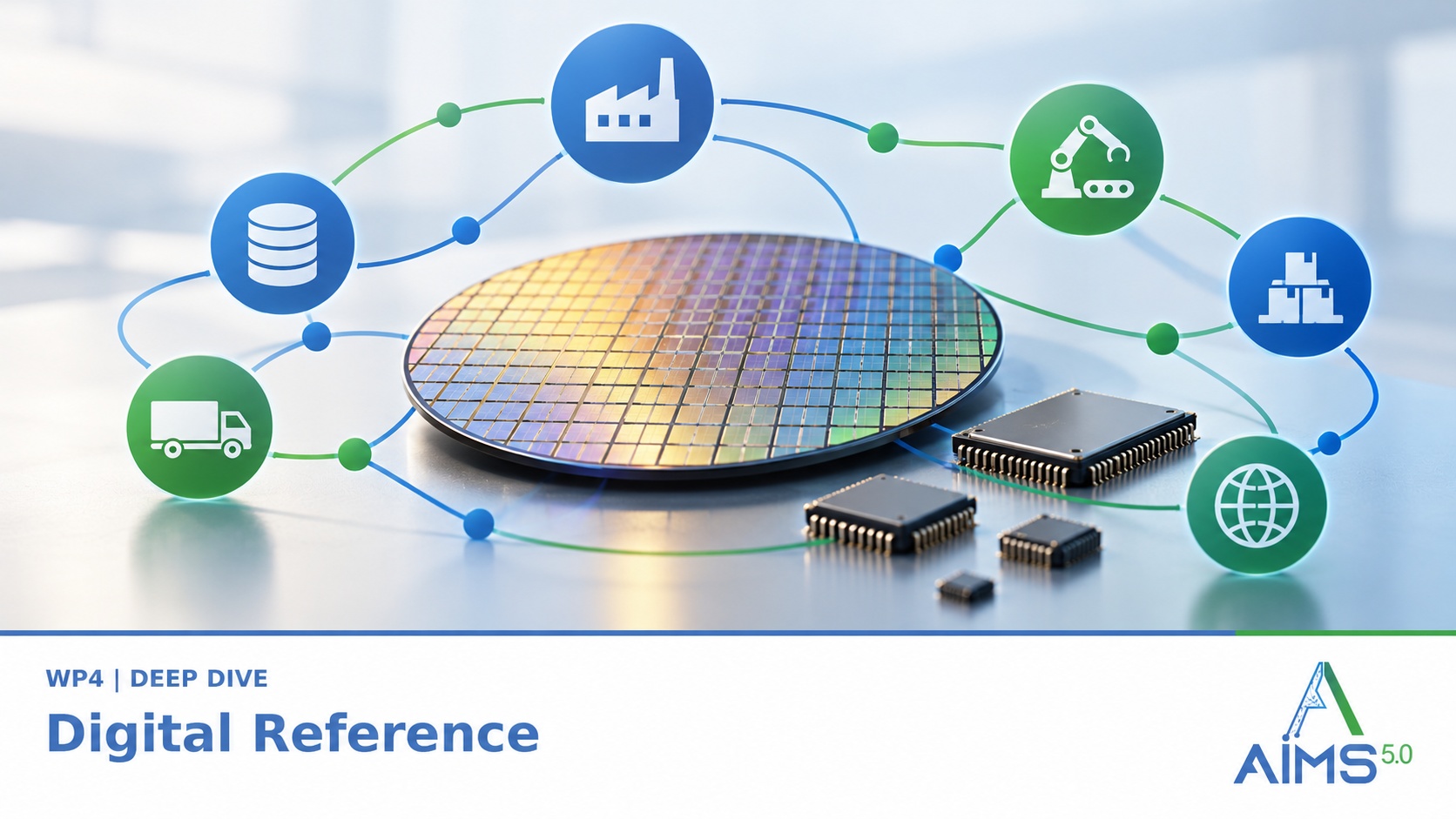
AIMS5.0 Deep Dive, part 4 of 9 · Work package 4: Digital Reference and Open Access Platform
A semiconductor supply chain involves many companies: wafer fabs, assembly and test sites, distributors and the manufacturers of cars, phones and industrial equipment. Each of them describes products, processes and capacities in its own terms. When data moves between them, a large part of the effort goes into mapping one set of terms onto another. Work package 4 (WP4) of AIMS5.0 developed a common semantic model for the industry and a platform to work with it. The work package was co-led by Hans Ehm (Infineon) and Lars Mönch (FernUniversität in Hagen).
The Digital Reference
The core of WP4 is the Digital Reference, an ontology that describes semiconductors and their supply chains in a form that both people and software can read. Its goal is to become the semantic web standard for the semiconductor industry. Development started in the Productive4.0 project in 2017 and continued in SC³ in 2020. Today the model is also used in SC4EU and discussed for standardisation in Semiconductor-X.
The Digital Reference is divided into lobes, each covering one domain such as planning, supply chain or sustainability. It now has 15 lobes and more than 1,500 classes. In AIMS5.0 the team added three lobes, made more than 30 updates to the existing model and checked it for inconsistencies. The project's use cases contributed 641 new classes to the wider Digital Reference ecosystem. WP4 also tested how large language models can extract ontology elements from long technical documents.
Since February 2025 the model has been published under the Apache 2.0 licence. The partners deliberately filed no patents, to keep it openly accessible. The model can be browsed and downloaded on its public website, and an interactive learning tool lets users explore it class by class. New lobes and classes can be added without changing the existing structure.
A quality management lobe
One of the new lobes covers quality management. Infineon and NXP developed it together and brought their different company practices into one shared model. Integrating the lobe revealed missing cross-references to other parts of the Digital Reference, which the two teams resolved together. Joint work of this kind between competitors shows that a shared model can serve the whole industry. The quality lobe supports traceability: when a customer complaint comes in, the history, location and status of the product can be followed in full. It is currently being discussed with quality management experts in both companies.
The Open Access Platform
The Open Access Platform (OAP) makes the Digital Reference usable in practice. It is an ontology management system with functions for visualisation, querying and access management, implemented together with DAC.digital. Its marketplace contains ontology models for 17 of the 20 AIMS5.0 use cases.
The platform shares metadata, while raw production data stays at each company's site. A company can connect its own sub-ontology, reuse models from existing use cases and run tools where the level of trust allows it. Typical users include a wafer fab planner who runs production planning on data held on site, a sustainability manager who shares metadata for certification, and a tool developer who builds new applications on published metadata.
Two tools on the platform
Two tools are running on the platform and can already be demonstrated. The carbon handprint tool is based on an ontology that reflects European regulation: the rules for product carbon footprints, the Digital Product Passport, which will be mandatory for all product types by 2030, and the Corporate Sustainability Reporting Directive. It maps scope 1 to 3 emissions along the value chain and lets users compare the CO₂ emissions and savings of different products or suppliers. Because the model is generic, any company in a supply chain can use it.
The second tool supports production planning in a wafer fab. FernUniversität in Hagen designed and tested a simulation-based optimisation approach for planning a single wafer fab and compared rule-based and optimisation-based strategies for releasing orders into production. In the tested cases the approach outperformed conventional planning. The work was presented at the Winter Simulation Conference 2025.
Access control with Eclipse Arrowhead
Sharing metadata between companies requires clear rules on access. Together with work packages 1 and 3, WP4 applied the security model of Eclipse Arrowhead to the platform: Arrowhead's service registry, orchestration and authorisation systems control who can use which OAP data and tools. A live demonstrator applies the same approach to a new data source. Data from a smart wristband is streamed through the Arrowhead cloud in near real time into a knowledge graph aligned with the Digital Reference, where it can be queried under Arrowhead access control.
After the project
WP4 delivered its five deliverables and added work beyond the original plan: ontologies for all use cases, the carbon handprint and planning use cases, and the quality management lobe. The Digital Reference continues in SC4EU, which already uses the ontology curation portal developed in WP4, and new proposals have been submitted to develop the model further. The partners also promote it through the Industrial Alliance on Semiconductor Technology.
The WP4 team will be at the AIMS5.0 booth at EFECS 2026 in Helsinki on 2 and 3 December. An overview of all nine work packages is available in the AIMS5.0 final results article.
The AIMS5.0 project is supported by the Chips Joint Undertaking and its members, including top-up funding by National Funding Authorities from involved countries under grant agreement no. 101112089.




 Imprint
