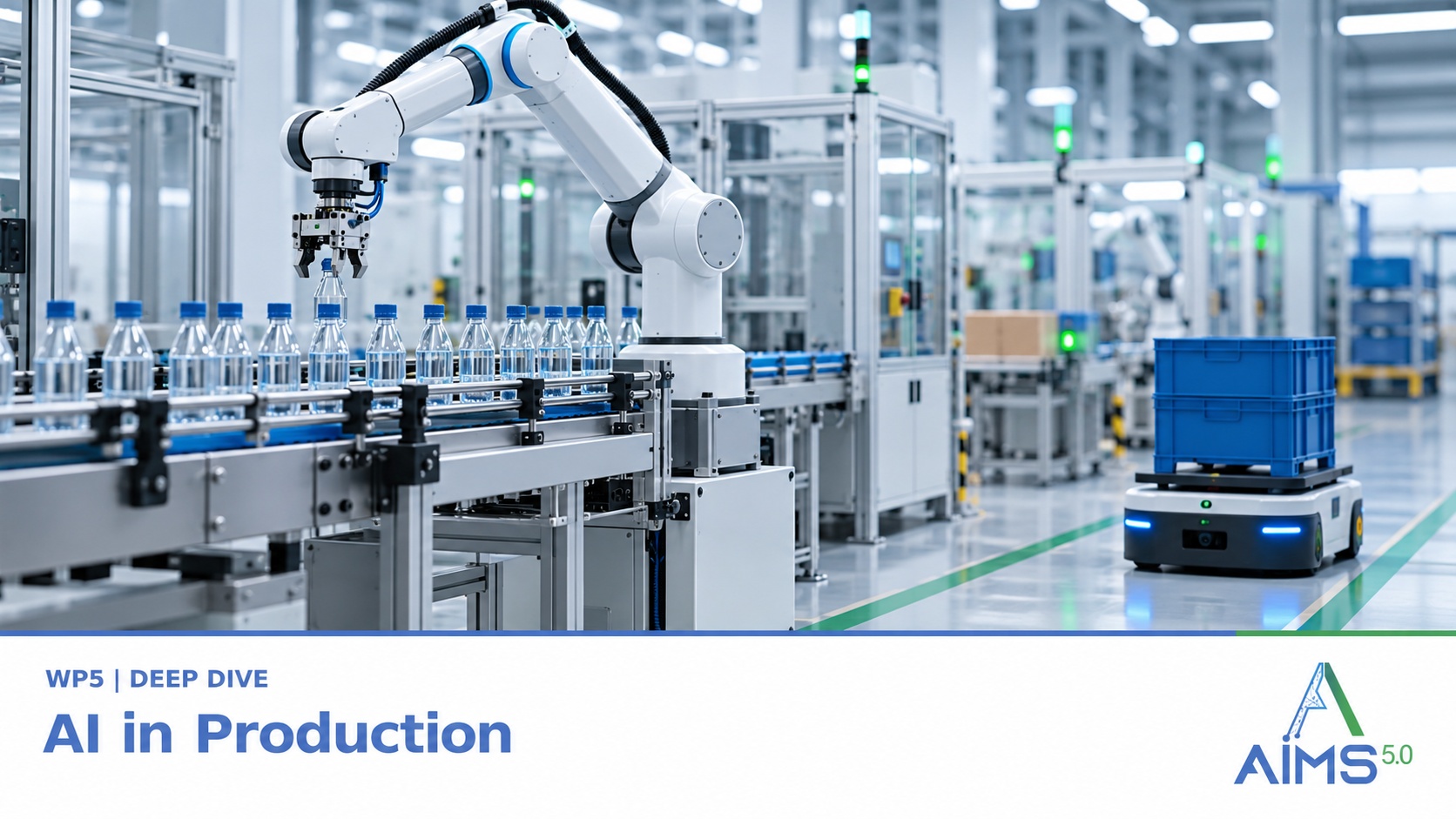
AIMS5.0 Deep Dive · Part 5 of 9 · Work package 5
A factory needs more than an accurate AI model. It needs a system that fits its equipment, production routines and the people who work with it. Work package 5 of AIMS5.0 addressed that task through eight use cases for original equipment manufacturers and Tier 1 stakeholders. Led by Thomas Irrenhauser of BMW and co-led by Eduardo Juárez of Universidad Politécnica de Madrid, the work brought together 24 partners from eight countries.
The applications ranged from energy and quality monitoring to autonomous logistics, machine tools and assistance for workers. Their maturity differs: some results are already used in industrial operations, while others remain demonstrators or need further pilot evaluation.
Energy and quality in production
UC1 developed methods and software for analysing energy use and carbon footprints at Cetto. Its reusable results include an energy and CO₂ data model, calculation logic and tools for comparing energy and transport scenarios. Further pilot evaluation is needed to develop these into an industrially viable solution.
In UC2, process mining and a quality dashboard help investigate production quality on the Philips OneBlade line. The dashboard is in use, while a separate strand on robotic testing for intense pulsed light devices continues after the project. These two strands illustrate why the status of a work package cannot be reduced to one readiness label.
Services and factory logistics
UC3 developed a Zero Administration platform and edge AI for service delivery. The approach is running in a live service at Husqvarna. It connects the technical work on AI with the practical need to manage connected devices and services with less manual administration.
UC4 addressed the connection between production and logistics. BMW worked on autonomous drone scanning and the creation of maps for autonomous mobile robots. The final review describes a route towards regular operation and wider rollout. UPM also developed a 3D reconstruction pipeline, with open-source software and engineering services identified as routes for further use.
Machine tools and robotic handling
UC5 applied AI to the machine tool domain, including real-time tool breakage detection on Soraluce machines at GOIMEK. The results include monitoring technology and associated know-how. Potential routes to use include integration, licensing and services; the results should be assessed against the requirements of each industrial application.
UC6 developed a robot that picks randomly piled bottles and places them on a moving conveyor. This combines perception, motion planning and accurate placement in a changing environment. The final review places the result at TRL 5, moving towards TRL 6, with potential use as individual AI modules or a complete robotic workcell.
Manufacturing methods and support for workers
UC7 explored a digital manufacturing platform for luminaires. Signify developed low-cost metal 3D printing using directed energy deposition as an alternative to die casting and is pursuing industrialisation. Other strands had different outcomes: a computer-vision pilot was stopped, while DAC developed a proof of concept for work involving synthetic defects and data annotation. These results have separate development and exploitation paths.
UC8 focused on interaction between people and manufacturing systems. It combined human-aware mobile robots with an upper-body exoskeleton controlled through brain signals. The robotics work includes camera and LiDAR perception, human tracking, gesture recognition and audio feedback that communicates robot intentions. The modules were validated in representative industrial scenarios, with further industrialisation envisaged with robot manufacturers, OEMs and Tier 1 suppliers.
What continues after AIMS5.0
WP5 leaves a set of results at different stages of adoption. Existing industrial uses provide a basis for further deployment. Validated robotic and monitoring modules offer routes through integration and licensing. Earlier-stage energy tools, testing methods and proofs of concept need further evaluation with industrial users.
For a manufacturer considering these results, the next step is to identify the relevant use case and establish its technical maturity, integration requirements and conditions for reuse with the result owner. The final review identifies Thomas Irrenhauser and Eduardo Juárez as the WP5 lead contact points.
The AIMS5.0 project is supported by the Chips Joint Undertaking and its members, including top-up funding by National Funding Authorities from involved countries under grant agreement no. 101112089.


 Imprint
